
China Aluminum Checkered Plate Manufacturers with Superior Anti-Slip Performance
2026-09-15
When safety and durability meet on a warehouse floor, the choice of tread plate often says more than any handbook. Aluminum checkered plates are the quiet backbone of slip-prone environments, but not all anti-slip surfaces are equal. In China, a newer wave of manufacturers is redefining superior grip with precision embossing, consistent alloys, and honest batch testing. One name that keeps surfacing is Sanhe Steel—known for plates that hold traction long after cheaper options turn smooth and hazardous. If you've been burned by shiny promises of anti-slip that don't survive a wet season, this guide unpacks what actually separates China's top aluminum checkered plate manufacturers.
Where China's Checkered Plate Gains Its Grip
Checkered plate earns its keep wherever boots meet metal. Loading docks, mezzanine walkways, stair treads, and truck beds are the usual proving grounds, but the real test is less visible. It sits in the way the pattern is rolled—whether the diamonds rise high enough to bite into a sole without catching a cart wheel. Chinese mills have spent years refining that balance, and it shows in the plate that keeps its profile after thousands of forklift passes.
That grip also travels into tougher corners. Ship engine rooms, offshore platforms, and rail maintenance vehicles depend on the same surface to hold steady against oil, salt spray, and constant vibration. In those places, thickness and pattern depth aren't generic specs. They are chosen for the exact kind of abuse the floor will take, and the better suppliers treat each order as a question about the site first. That small shift in attention is what keeps a checkered sheet from becoming just another piece of steel.
Pattern Depth and Raised Bar Design, Explained
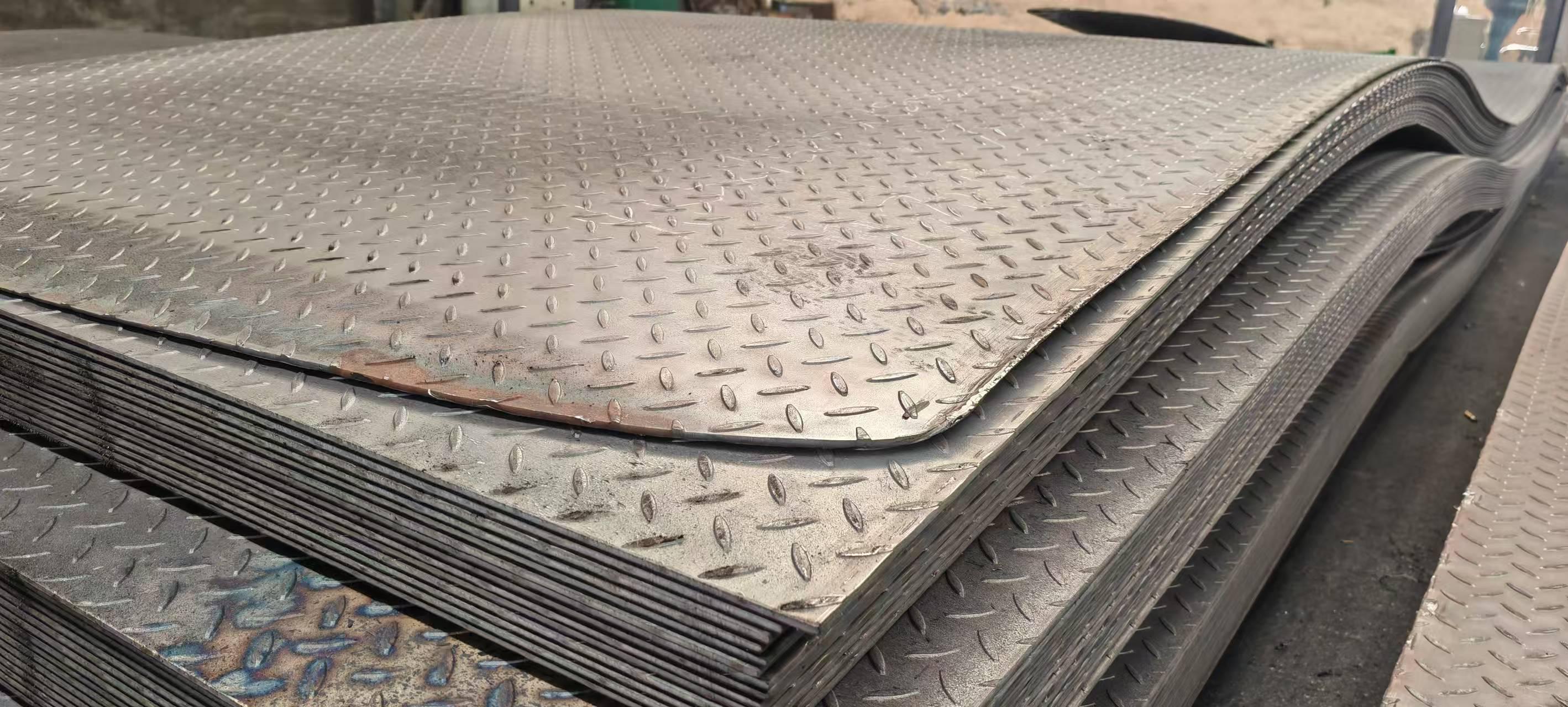
Take a close look at any textured panel and you'll notice that the perceived depth comes from two separate elements: the carved-out recess and the raised bar that frames it. The depth itself is often less important than the bar's edge profile—a sharp edge catches the eye, while a rounded edge feels softer and less deliberate.
In materials like molded plastic or stamped metal, the relationship between pattern depth and raised bar height determines how light moves across the surface. A taller bar next to a shallow recess can cast a stronger shadow, making the pattern appear deeper than it actually is. This trick is frequently used in product design to add visual weight without compromising structural integrity.
From a tactile standpoint, raised bars give fingers a clear path to follow, which is why you often see them on grips, buttons, and decorative trim. The spacing between bars matters just as much as their height—too dense and the pattern feels busy, too wide and the depth gets lost. Well-balanced designs let the recesses breathe while keeping the bars prominent enough to read as intentional.
Alloy and Temper Combinations That Hold Up Underfoot
Walk into any heavy-traffic facility and the floor tells you everything. Alloy choice matters less on a spec sheet than under a loaded cart or wet boot. 6061-T6 brings stiffness and dent resistance to ramps and platforms, but it can be overkill for a simple indoor walkway where 3003-H22 handles scuffs without the extra cost.
For wet or coastal settings, 5052-H32 and 5086-H116 make more sense. They shrug off salt spray and standing water better than heat-treated 6xxx series, and their moderate strength keeps panels flat without brittle cracking. The temper is the quiet half of the equation: H32 and H116 offer a balance of formability and hardness that survives repeated foot traffic, while T6 gives you the load-bearing backbone for mezzanines and dock plates.
The trick is matching the temper to the abuse. A diamond tread plate in 3003-H22 is easy to fabricate and fine for light footfall. But if forklifts roll across the same surface, step up to 6061-T6 or at least 5052-H32 so the pattern doesn't flatten out. Underfoot, the right alloy-temper pair is less about chemistry and more about whether the floor still looks like a floor after a decade of boots.
Inside the Factory: Anti-Slip Testing Methods
Walk through the testing bay and you'll see a pendulum skid tester bolted to the floor, its rubber slider dressed in a fresh piece of shoe sole material. The operator swings the arm from horizontal and reads the needle as it drags across the tile surface, giving a friction coefficient that has to clear a minimum threshold before the batch ships. It's a deliberately low-tech ritual that catches more defects than any spec sheet ever could.
Next to it sits a motorised tribometer running a continuous loop over a wet sample, logging how the surface behaves after thousands of passes. This is where subtle glaze or polish issues show up, the kind that pass a single swing but fail after simulated foot traffic. Technicians rotate the sample 90 degrees halfway through to avoid directional bias, and the software flags any reading that dips below the line.
For ramps and stair treads, a full-size incline rig tilts until a weighted sled with a standard sole material starts to slide. The angle at breakaway gets converted into a slip resistance rating, and anything within two degrees of the pass mark triggers a re-test on a fresh tile from the same kiln run. No one loves the extra work, but it's cheaper than a recall.
Getting the Right Size, Thickness, and Edge Finish
Getting the size right starts with measuring the actual opening or surface, not relying on nominal dimensions from a previous order or a rough guess. Use a steel tape or digital caliper in three spots—left, center, right—and take the smallest reading if the part needs to slide in, or the largest if it sits on top. Most shops allow a tolerance of plus or minus 1/16 inch, but if your frame has tight corners or the material expands with humidity, bump that to 1/8 inch. A common mistake is adding a “safety margin” twice, once in your notes and again when placing the order, which leaves you with a piece that’s too small to trim later.
Thickness isn’t just about strength; it changes how the piece feels, how it handles fasteners, and whether it lies flat. For a workbench top or a shelf that spans more than 30 inches, 3/4 inch is the practical minimum—anything thinner will sag under a stack of books or a tool chest. If you’re laminating or need edge profiles like a bullnose, go up to 1 inch so there’s enough material to shape without weakening the core. On the flip side, panels for drawer bottoms or cabinet backs rarely need more than 1/4 inch, and over-thickening there just adds weight and cost. Ask yourself what the piece will actually carry, then add 1/8 inch if you plan to sand or refinish later.
Edge finish often gets picked last, but it’s the first thing your hands and eyes notice. A squared, sharp edge is fine for hidden parts, but for anything exposed, a 1/8-inch roundover or chamfer prevents splinters and paint chipping. If the piece will be handled daily—like a cutting board or a desk front—go with a full bullnose or a soft radius, which also hides minor surface scratches better than a crisp corner. For metal or acrylic, specify whether you want a deburred edge, a brushed finish, or a polished bevel; each one changes how light hits the piece. Don’t assume “standard” means the same thing at every supplier—send a photo or a small sample if you can, and write down the exact edge spec on the order so there’s no back-and-forth after delivery.
Protecting the Pattern from Mill to Job Site
Getting a pattern from the mill to the job site without damage starts well before it leaves the shop floor. The usual shrink-wrap and a few corner guards won’t cut it once the load hits rough gravel or gets shuffled between trucks. Instead, brace the pattern onto a dedicated pallet with steel banding, then add a layer of 1/4-inch plywood over any raised edges or indexing pins. That keeps the reference surfaces from getting nicked in transit.
Moisture is the quieter problem. A pattern that leaves the mill bone-dry can still pick up enough humidity in an open trailer to swell by a few thousandths—enough to throw off a match line. Seal the pattern in a vented, desiccant-lined cover rather than plastic alone, so condensation doesn’t pool against the edges. Swap out the desiccant if the job site is more than a day away.
Once the pattern arrives, don’t let the crew treat it like ordinary lumber. Tag one corner as the reference datum and keep that corner off the ground at all times. Lay it flat on blocking, keep it out of direct sun, and check the twist with a straightedge before the first layout. A small ding in the wrong place can cost more in rework than the entire shipping crate.
FAQ
Chinese mills have invested heavily in advanced rolling and embossing lines, so the raised patterns come out crisp and uniform. That consistency directly improves slip resistance, especially when paired with 1060 or 3003 grade aluminum.
You'll find them on truck beds, emergency vehicle steps, walkways in food processing plants, and marine decking. Anywhere wet, oily, or muddy footwear is common, the pattern helps stop slips without adding much weight.
During rolling, one side passes through textured rollers that press a raised diamond or five-bar pattern into the metal. The projections give footwear something to grip, while the valleys let water or oil drain away instead of pooling.
Yes, most manufacturers will cut to length and width, and common thicknesses run from 1.5 mm to 6 mm. If you need a non-standard pattern height or a specific alloy, it's worth asking whether they can adjust the tooling.
Many suppliers offer bright polished, anodized, or powder-coated finishes. Anodizing adds a harder surface layer that can improve corrosion resistance, though it slightly reduces the sharpness of the raised pattern.
Ask for a sample and check that the pattern is even across the full sheet, with no flat spots or shallow embossing. Also confirm the alloy composition and tensile strength with a mill test certificate rather than relying only on visual appearance.
Yes, if you choose 5052 or 3003 alloy with a protective anodized or coated finish. Bare 1060 will work indoors but may corrode faster near salt water, so matching the alloy to the operating environment matters.
For standard sizes already in stock, shipment can happen within 7 to 15 days. Custom cuts, special thicknesses, or surface treatments usually add another 10 to 20 days, depending on the factory's current schedule.
Conclusion
The anti-slip capability of Chinese aluminum checkered plate rests on more than a raised surface. Leading manufacturers control the bar pattern's height, spacing, and profile with tight tolerances, often keeping the raised diamond or five-bar design between 1.0 and 1.5 millimeters above the base. That depth gives footwear and wheeled equipment enough mechanical interlock to resist sliding, even when the plate is wet or lightly oiled. Just as important is the alloy and temper. Mills typically run 3003, 5052, or 6061 in H22, H32, or H114 tempers, balancing formability with hardness so the pattern does not flatten under repeated foot traffic or cart wheels. The base thickness, usually from 1.5 to 6 millimeters, works with the bar profile to maintain grip over years of use.
Inside the factory, anti-slip performance is verified rather than assumed. Pendulum tests and inclined-platform friction measurements are common, and some plants run abrasion cycles to confirm the raised bars retain their profile after simulated wear. Buyers can specify cut-to-size sheets, mill or sawn edges, and even laser-cut shapes without losing the pattern's effectiveness near the edges. To keep that grip intact from the mill to the job site, manufacturers apply peelable films, interleaving paper, or custom crating that prevents the raised bars from being crushed or scratched in transit. This combination of controlled geometry, proven alloy selection, verified friction, and careful packaging is what separates Chinese suppliers with genuinely superior anti-slip performance from those that only imitate the surface look.
Contact Us
Contact Person: Zoey
Email: [email protected]
Tel/WhatsApp: +86 15865577002
Website: https://www.sanhesteels.com