

China Surge Arrester Technologies Enhance Power Grid Resilience
2026-09-26
A single lightning strike can plunge entire regions into darkness, yet behind that flash lies a relentless test of grid resilience. In China, surge arrester technology is rewriting how power networks absorb and deflect these violent surges—turning vulnerability into controlled strength. At the forefront of this shift, Lugao is redefining what it means for a grid to stand firm when the sky turns hostile.
The ZnO Formula Shift Behind Longer Arrester Life in High-Altitude Substations
At elevations above 2,000 meters, air density drops enough to weaken convective heat transfer from surge arresters. A standard ZnO varistor disc that runs safely at sea level can develop hot spots under the same continuous operating voltage because waste heat leaves the housing more slowly. The revised formula attacks this problem at the grain boundary layer, where most of the non-linear conduction occurs. By shifting the bismuth-antimony ratio and adding a controlled fraction of gallium, manufacturers narrow the distribution of barrier voltages across individual grains. Fewer weak junctions mean less localized leakage current during steady-state operation, so the disc runs cooler even when the surrounding air is thin.
High-altitude sites also suffer from rapid temperature swings and stronger ultraviolet exposure, which can embrittle standard polymer housings and encourage surface tracking. The new ZnO blend is paired with a slightly higher residual voltage gradient per millimeter. This allows a shorter active column for the same rated voltage, reducing the physical height of the arrester without sacrificing protection margin. A shorter column is less prone to uneven voltage distribution under fast-front overvoltages, a condition that becomes more critical at altitude because the air gap insulation recovers differently after a lightning impulse. The formula change therefore supports a more compact design that resists internal partial discharge over many seasons.
Long-term field data from plateau substations in the Andes and the Tibetan Plateau show a measurable reduction in resistive leakage current growth after five years of service. Instead of the typical upward drift that signals impending thermal runaway, arresters with the adjusted ZnO chemistry maintain a stable watt-loss profile. The key is not a single additive but a shift in sintering atmosphere during production, which modifies the oxygen vacancy concentration in the depletion layer. This subtle stoichiometric change improves ageing resistance against repeated energy stresses without pushing the protection level too high. As a result, utilities can extend inspection intervals and replace fewer units over the same operational lifetime.
Polymer vs Porcelain: What China's Coastal Grid Data Actually Shows
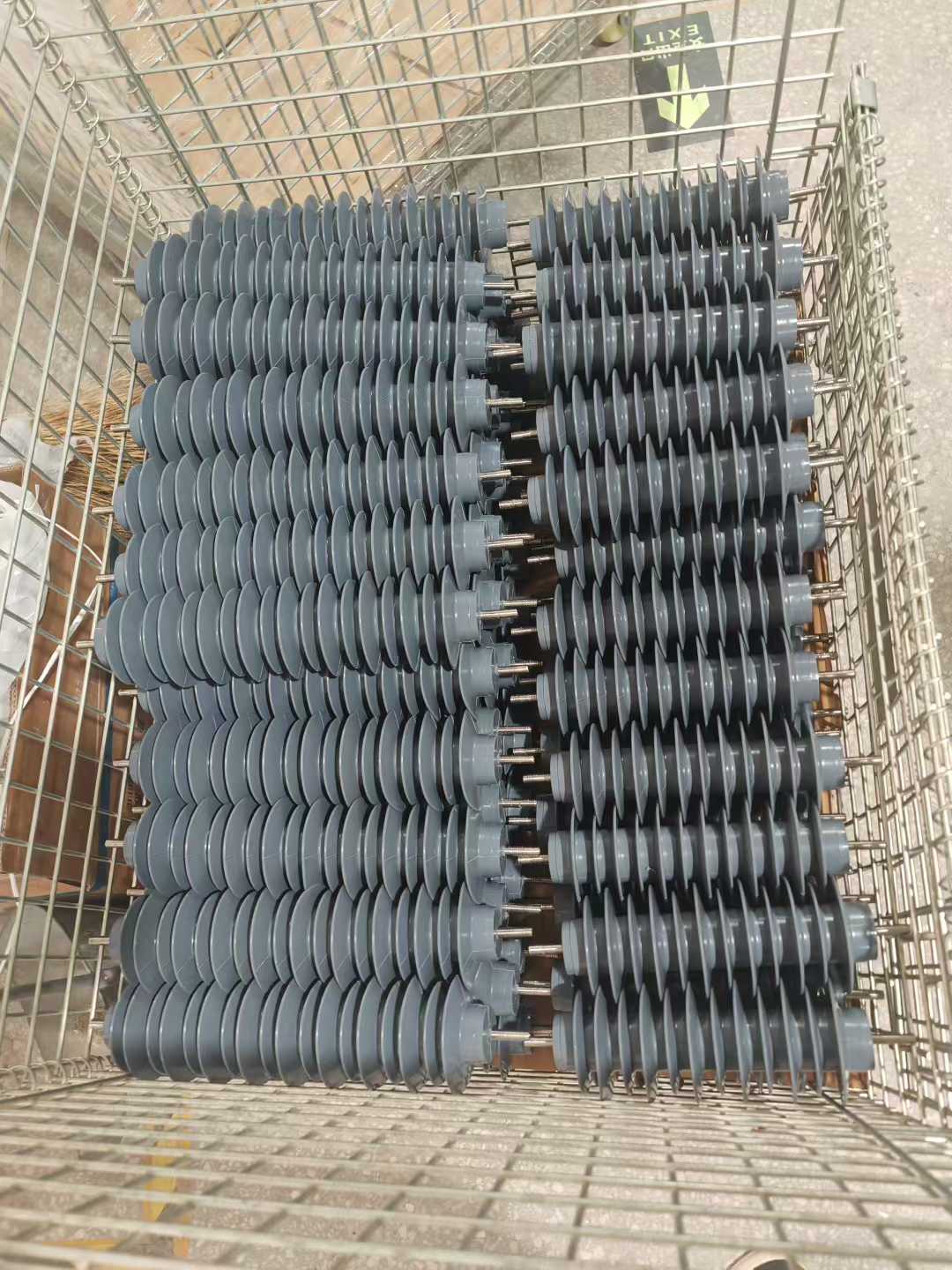
China’s coastal substations have long favored porcelain insulators for their mechanical strength, but recent field data from salt-heavy provinces like Fujian and Zhejiang tells a more nuanced story. Polymer housings, especially silicone rubber, show lower leakage current under the same equivalent salt deposit density, and they recover hydrophobicity after fog events far faster than glazed porcelain. That gap widens within 5–10 km of the shoreline, where porcelain sheds accumulate a conductive film that leads to dry-band arcing during early morning condensation.
What the grid data doesn’t show is a clear winner. Porcelain still holds an edge in puncture resistance and long-term UV stability, while polymer units occasionally suffer from tracking or erosion around the end fittings if the housing was poorly bonded. Across 110 kV and 220 kV coastal feeders, outage records suggest polymer strings reduce pollution-related flashovers by roughly half during October-to-March salt storms, but the margin narrows inland where dust and cement plant emissions dominate the pollution layer.
The real insight from the data is that material choice matters less than maintenance assumptions. Utilities that kept porcelain wash cycles unchanged saw no improvement after switching to polymer, while those that adjusted inspection intervals and infrared monitoring caught early degradation before it became a fault. In that sense, the coastal grid data doesn’t crown one material—it exposes the operational habits that make either material reliable.
Smart Leakage Current Sensors Are Rewriting Maintenance Schedules
For decades, maintenance teams relied on calendar intervals to test insulation. A motor might get a megger test every six months, regardless of whether it actually needed attention. Smart leakage current sensors flip that logic. They watch the tiny current that always leaks through insulation—current that rises as windings absorb moisture, dust builds up, or cable jackets crack. Instead of waiting for the next scheduled shutdown, the sensor flags the trend early, when the fix is still a matter of cleaning or drying rather than rewinding.
The real shift comes from how these sensors handle noise. Older leakage monitors were notorious for nuisance trips, so crews often ignored them. Newer devices log high-resolution waveforms and apply adaptive thresholds that learn what normal looks like for each circuit. When something drifts outside that envelope, the sensor pushes a notification with the raw trend data attached. Maintenance planners can then bundle several small interventions into one planned outage instead of chasing a surprise failure at 2 a.m.
The effect on scheduling shows up fastest in plants with aging switchgear or long cable runs. One facility cut its annual electrical maintenance hours by roughly a third after retrofitting leakage sensors on critical feeders, simply because technicians no longer had to open every panel for a manual insulation check. The sensors also caught a deteriorating bushing on a 4,160-volt transformer three weeks before it would have flashed over. That kind of lead time changes the conversation from 'what broke?' to 'what do we fix next month when it's convenient?'
Why 800kV Converter Stations Now Demand Double-Stage Protection
Operators of 800kV converter stations have long relied on single-stage surge arresters, but recent field failures and switching transient studies reveal a growing vulnerability: the sheer energy throughput at this voltage level can momentarily exceed the thermal limits of a single arrester stack. When a DC line fault or converter blocking occurs, the resulting overvoltage waveform is not a simple impulse but a complex, multi-ms event where the first peak may be handled, yet the residual energy continues to stress the same elements beyond their rated charge. This has pushed engineers to reconsider the assumption that one protection stage is sufficient.
Double-stage protection addresses this by splitting the energy absorption between two coordinated devices: a primary, fast-acting arrester that clips the initial peak, and a secondary, higher-energy unit that absorbs the long-duration tail without letting the voltage drift above insulation coordination limits. The gap between their operating points is carefully tuned so that neither stage is forced to work alone during worst-case conditions. In practice, stations that adopted this approach after repeated unexplained arrester thermal runaways now report a marked drop in unplanned outages and a more predictable degradation curve for the protective elements.
What makes this shift particularly urgent today is the increasing use of hybrid DC breakers and modular multilevel converters, whose internal capacitances and control delays introduce new resonance modes. These modes can produce double-peak overvoltages that single-stage designs cannot clamp effectively without sacrificing operating margin. Double-stage protection therefore isn't just a safety upgrade—it's becoming a design requirement for anyone who wants to avoid the hidden cost of premature equipment aging and the downtime that follows.
Lightning-Rich Provinces Put Arrester Designs to the Test
In regions where thunderclouds stack high above the horizon with unsettling regularity, surge arresters are not just installed—they are interrogated. Guangdong, Yunnan, and Sichuan routinely log some of the highest cloud-to-ground flash densities in the country, turning ordinary substations into unintended laboratories. Every storm season, arrester housings face moisture ingress, internal varistor degradation, and the slow creep of partial discharge that no datasheet fully predicts. Field crews have learned to read the subtle signs: a faint ozone smell after a nearby strike, thermal discoloration on a silicone skirt, or a leakage current monitor that twitches erratically on humid nights. These provinces have become the proving ground where designs either earn a decade of quiet service or fail within two monsoons.
The test is not merely about surviving a single massive surge. Real-world lightning brings multiple strokes in rapid succession, often combined with induced overvoltages from nearby lines. Arrester specifications written in calm laboratory terms—8/20 µs impulses, nominal discharge currents—struggle to capture the brutal, random energy delivered by a supercell complex. Utilities in lightning-dense areas have pushed manufacturers to rethink end-cap sealing, improve gradient control rings, and adopt more aggressive aging tests that mimic years of damp heat and salt spray. Some provincial grids now require surge counters and online monitoring on every critical arrester stack, precisely because past failures were too quiet until a porcelain housing shattered across a busbar.
What emerges from these high-strike provinces is a quiet evolution in arresters, not headline-grabbing but deeply practical. Designs that survive Yunnan's plateau thunderstorms or the typhoon-fed lightning of coastal Guangdong tend to share common traits: polymer housings with hydrophobic recovery, robust pressure relief paths, and internal structures that tolerate thermal shock without micro-cracks. Engineers elsewhere borrow from these lessons even where lightning is rare, because the same weaknesses exposed by a heavy storm season—sealing flaws, poor contact surfaces, inadequate energy absorption—also shorten arrester life under switching surges and pollution. In the end, lightning-rich provinces do the hard testing that every grid quietly benefits from.
Next Up: Self-Healing Varistors and the End of Routine Replacement?
For decades, metal oxide varistors have been treated as sacrificial components. After a handful of severe surges, their internal grain boundaries degrade, clamping voltage drifts, and the only real fix is to swap in a fresh unit. Maintenance schedules are built around this predictable failure, with spare parts stocked and technicians dispatched on a regular basis. But a new generation of self-healing varistors is starting to rewrite that playbook.
The idea borrows from self-repairing polymers and ceramics. When a high-energy transient creates microcracks or localized melting, embedded additives migrate to the damaged site under the applied electric field. They reconnect fractured conductive pathways and restore the nonlinear current-voltage curve to within a few percent of its original shape. In lab tests, varistors have survived dozens of 8/20 µs pulses that would normally push a standard unit past its end of life, all without any external intervention.
This doesn't mean maintenance teams can throw away their calibration tools just yet. Long-term behavior under combined AC stress, humidity, and thermal cycling is still being mapped, and industry standards for self-healing performance have not been finalized. But the direction is clear: rather than treating varistors as disposable fuses, engineers may soon specify them as durable, field-recoverable devices. Routine replacement could become the exception, not the rule.
FAQ
Utilities are noticing that domestic ultra-high-voltage builds forced Chinese manufacturers to solve real reliability problems, from metal-oxide varistor aging to pollution flashover, and those fixes carry over into export models.
The zinc oxide discs are tuned for low residual voltage during a surge while keeping leakage current tightly controlled, which means fewer nuisance trips and longer service life under continuous voltage stress.
Silicone rubber housings with deep creepage profiles are common, and the hydrophobic surface allows water to bead away rather than forming a conductive film, so salt fog and industrial dust cause fewer external flashovers.
Running arresters on 1,100 kV lines leaves little room for error. That operating record, plus frequent switching surges from long-distance transmission, gives Chinese suppliers a testing ground that most rivals simply do not have.
Many manufacturers now certify to IEC 60099 and regional utility specifications, and some even offer custom grading ring adjustments so the unit matches existing insulation coordination studies without re-engineering the substation layout.
Beyond clamping lightning overvoltages, their thermal stability under repeated strikes prevents sudden failures that would otherwise cascade into outages, keeping the line energized until crews can inspect it.
Some units include built-in leakage current sensors or discharge counters, allowing maintenance teams to spot degradation early instead of relying on scheduled replacement cycles.
The scale of domestic production lowers costs, but the real appeal is shorter lead times and the availability of complete support hardware, from brackets to monitoring devices, in one shipment.
Conclusion
China's surge arrester field has quietly shifted from one-size-fits-all hardware to environment-specific engineering. The revised ZnO formulation, with carefully tuned grain boundary additives, slows degradation in high-altitude substations where low air density weakens heat dissipation and strong UV exposure accelerates surface aging. Coastal data from Guangdong and Fujian reveal that polymer housings resist salt fog and pollution flashover better than porcelain, yet porcelain remains preferred where mechanical stress from typhoon winds is extreme. This dual-track material choice means grid planners no longer treat arresters as interchangeable parts but as components matched to local stress profiles.
Meanwhile, smart leakage current sensors now separate resistive from capacitive current in real time, flagging early moisture ingress or varistor degradation long before thermal runaway. At 800kV converter stations, double-stage protection has become standard because switching overvoltages and lightning surges can arrive almost simultaneously, a condition single-stage arresters cannot safely clamp. Provinces with frequent lightning, such as Yunnan and Hainan, run field trials that push new designs through rapid aging cycles. Looking ahead, self-healing varistors based on doped boundary layers are moving from lab to pilot, suggesting that routine replacement may eventually give way to condition-based retirement only after true end of life.
Contact Us
Contact Person: Doreen
Email: [email protected]
Tel/WhatsApp: 8618057712366
Website: https://www.liugaopower.com/