

Custom Carbonated Beverage Production Line Manufacturer for Reliable High-Volume Drink Production
2026-09-19
Scaling up carbonated drink production brings a familiar set of headaches: inconsistent carbonation, bottlenecks on the line, and equipment that struggles to keep pace with demand. You need a partner who understands that high-volume output doesn't mean sacrificing precision or reliability. INTOP Machinery designs and builds custom beverage production lines engineered for exactly that balance, so you can focus on growing your brand while your line keeps up.
Custom Carbonation Lines That Match Your Exact Output Targets
A carbonation line built around a fixed set of modules rarely lands exactly where production demands it. Instead, the layout, tank sizing, pump duty, and pipe runs are calculated from your required hourly throughput, fill temperature, and CO2 dosing range. Whether the target is 2,000 bottles per hour on a single shift or 20,000 cans across three shifts, the equipment footprint and control logic are set up so the line hits that number without constant manual overrides.
Output accuracy comes from matching the carbonation process to the filler speed and container type. Inline carbonators with mass flow meters adjust CO2 injection in real time, while buffer tanks with level and pressure transducers keep the supply stable during startups, changeovers, and short stoppages. That means the carbonation level you specify for a 330 ml can is the same in the first and last container of the run, even when the filler ramps up or slows down.
Project engineers usually finalize the line after reviewing your utility connections, floor space, and expected product variants. The goal is not to sell the largest system, but to deliver one that reaches your output target on day one, with spare capacity where you actually need it. This approach avoids the common problem of oversized equipment that wastes energy or undersized lines that become the bottleneck within a year.
High-Volume Drink Production Without the Usual Bottlenecks
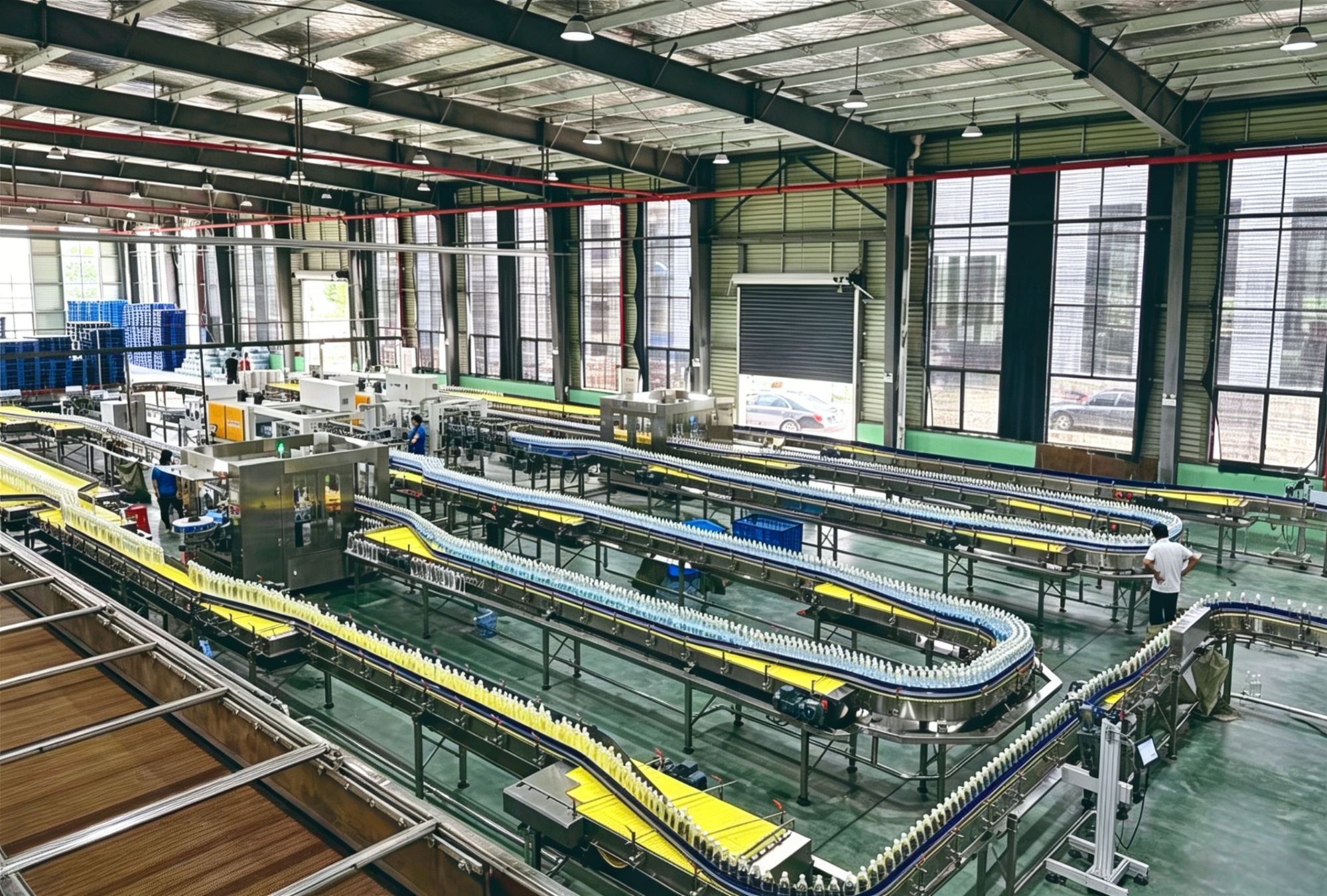
Scaling drink output usually hits the same wall: the filler, the mixer, or the labeler can't keep pace and every upstream stage backs up. The workaround that actually holds up is to stop treating each machine as an isolated speed rating. Instead, match flow rates at the interfaces—put a small buffer tank between pasteurization and filling, and run the filler slightly below its theoretical maximum so it never starves or jams. That slack absorbs the micro-stops that otherwise ripple through the whole line.
Another overlooked bottleneck sits in changeover time. A line that makes 20,000 bottles an hour but takes ninety minutes to switch flavors loses more weekly capacity than a slower line that swaps recipes in fifteen minutes. Pre-staging ingredients, using quick-connect manifolds, and dedicating one line to the highest-volume SKU keeps the upstream prep work from stalling production. Operators can then run longer blocks of the same recipe before the next washdown.
Quality checks often get bolted on at the end, which means a bad batch can be finished and packaged before anyone notices. Moving carbonation, fill level, and seal checks inline—especially after the filler and before the labeler—cuts rework and keeps rejected product from clogging the return conveyor. Combined with a simple daily review of the three slowest stations, this approach removes the usual stops without adding expensive automation.
Why Carbonated Beverage Lines Need More Than Standard Conveyors
Standard conveyors are built around a basic assumption: the product stays put and the line stays dry. Carbonated beverages break that assumption within seconds of leaving the filler. Residual pressure keeps pushing CO2 out of the liquid, producing foam, spray, and occasional container bursts. On a flat-top chain, that sugary runoff seeps into bearings, mixes with chain lubricant, and forms a gritty paste that accelerates wear and throws tracking off. A line that runs carbonated drinks needs open-framed slat construction, angled catch pans, and corrosion-resistant components—not just a standard belt with a few washdown nozzles.
Then there's the shock problem. A carbonated container is a pressurized system; a hard stop, a sharp turn, or a rough transfer can trigger sudden bubble formation inside the liquid. That often shows up as foaming at the filler, inconsistent fill levels, or lids that pop under pressure. Standard conveyors rely on abrupt lane changes and dead plates, which are exactly the kind of mechanical shocks that destabilize carbonation. Beverage lines handle this with gradual merges, low-backpressure accumulation, and servo-driven transfers that ease containers into position instead of slamming them. The goal isn't faster conveying—it's keeping the liquid calm from filler to packer.
A Manufacturer's Take on Keeping Drinks Crisp at Scale
When you're filling tens of thousands of cans an hour, the margin for losing that sharp, clean bite in a carbonated drink is razor thin. We learned early on that temperature control during carbonation isn't just a setting—it's the backbone of the whole operation. Chilling the liquid to just above freezing before injecting CO2 keeps the gas dissolved longer and tighter, so every can that leaves the line carries the same bright fizz you'd expect from a fresh draft pour. It took re-plumbing half the floor and recalibrating sensors every shift, but the result is a consistency that batch-level craft operations simply can't touch.
The real headache isn't the machinery—it's the quiet degradation that happens between filling and first sip. Light, oxygen, and even the lining of the can itself can steal crispness if you let them. We switched to a nitrogen-dosed headspace that pushes out residual air before seaming, and we run shelf-life trials every quarter with blind taste panels. The goal isn't just to hit a spec sheet; it's to make sure a can opened three months later in a hot warehouse still has that same cold, snappy finish. Small changes there have saved us more customer complaints than any new flavor launch.
Scaling up doesn't mean dulling the edges—it means refusing to let them get rounded off by logistics. We've started tracking dissolved oxygen levels not just at the filler but at the distributor's dock, and we adjust our carbonation curves for altitude and storage time. It's unglamorous work, but the payoff is a product that tastes deliberate, not mass-produced. When a drink still crackles on the tongue after a thousand miles and six months of shelf life, that's not luck. That's a manufacturer who refuses to let scale become an excuse.
Scaling Up Carbonated Output Without Sacrificing Bubble Quality
Boosting output in a carbonated beverage line often tempts engineers to simply crank up filler speed or enlarge the saturation tank, but bubble quality hinges on far more than raw throughput. The real bottleneck is usually the gas-liquid contact zone: as flow rates climb, the residence time inside the carbonator shrinks, and CO2 absorption becomes uneven. One practical fix is to install a static mixer immediately after the CO2 injection point, sized for the new volumetric load, then use an inline densitometer to trim the gas flow on the fly. This keeps the dissolved CO2 within a narrow band even when the filler accelerates, preventing the flat, coarse bubbles that plague rushed batches.
A second failure point shows up at the filler valves and transfer piping. When product velocity jumps from, say, 200 to 700 liters per minute, shear forces rise disproportionately and can strip out fine CO2 micro-bubbles before capping. The result is a bottle that tests at correct pressure but releases its gas too quickly when opened. Replacing abrupt elbows with long-radius bends, using low-shear impellers in the buffer tank, and adding a small nitrogen sparge ahead of the filler all help preserve the delicate bubble population. These changes cost less than a new line but often deliver the same quality gain.
Finally, pressure control during scale-up should shift from reactive to feedforward logic. A conventional PID loop on the carbonation tank may lag behind sudden demand changes, causing brief windows of under- or over-carbonation. By feeding the upstream flowmeter signal directly into the pressure regulator, the system can adjust saturation pressure before the surge reaches the tank. Calibrating the inline CO2 sensor weekly and running a small-batch shake test for bubble retention provides a reality check that line speed data alone cannot. Together, these steps let a plant double output while keeping the signature fine, persistent bubbles intact.
From Small-Batch Recipes to Reliable Full-Speed Production
Scaling up from a carefully tested small-batch recipe to continuous high-volume production is rarely a simple matter of multiplying ingredients. Subtle shifts in mixing intensity, heat distribution, and timing begin to surface once the batch size crosses a certain threshold. What worked beautifully in a five-gallon kettle may behave unpredictably in a five-hundred-gallon processing line.
The transition demands more than just larger equipment. It requires rethinking each step so that the character of the original product remains intact while the process becomes repeatable enough for around-the-clock operation. Parameters like shear rate, cooling time, and ingredient order often need recalibration, and sometimes a minor adjustment in one stage reveals an unexpected bottleneck in another.
Reliable full-speed production emerges when the recipe is treated as a living specification rather than a fixed formula. Teams that document the small-batch nuances, then systematically test them at pilot scale before committing to full runs, tend to reach steady output with fewer surprises. The goal is not simply to make more, but to make it the same way every single time.
FAQ
It covers the complete process from water treatment, syrup blending, carbonation, filling, to labeling and packing. Every section gets adjusted to your capacity and bottle shape, so it works more like a system built around your factory than a fixed set of machines.
We use industrial-grade filling valves and servo drives, add redundancy to critical parts, and recommend a preventive maintenance schedule. Most customers keep steady output across two consecutive shifts without unexpected stops.
Carbonation level, filling temperature, bottle changeover, label application, and the CIP cleaning setup can all be adjusted. If your recipe is oxygen-sensitive, we can also add deaerated water preparation and nitrogen blanketing.
Core components like filling pumps, valves, and the control system come from suppliers with long field records, and every line undergoes full integrated testing before shipment. We also reinforce corrosion protection and electrical shielding based on your water quality and workshop conditions.
Yes, but it normally requires swapping the filling module and adjusting the conveyor guides. We recommend optimizing for your main package format and reserving changeover interfaces, which keeps both cost and downtime lower.
It depends on hourly output and package type. From water treatment to palletizing you might need several hundred to over a thousand square meters, but a compact layout with a mezzanine platform can cut the footprint by about thirty percent.
Support includes remote diagnostics, operator training, annual maintenance, and spare part stocking advice. In some regions we station engineers nearby and can usually respond within 24 hours.
Conclusion
A custom carbonated beverage line starts with your actual output targets, not a catalog of one-size-fits-all modules. If you need 24,000 cans an hour or 8,000 glass bottles, the carbonation tanks, mixers, and filler speeds have to be sized together. Standard conveyors usually become the hidden bottleneck because carbonated drinks foam when they hit sharp turns or sudden stops, and warm product loses CO2 before it ever reaches the filler. So we build around counter-pressure fillers, in-line chillers that keep the liquid near 34–36°F, and conveyor layouts with accumulation zones and low-friction wear strips. That kind of planning removes the usual stops, starvations, and changeover pileups that quietly cut into high-volume output.
Scaling up without losing bubble quality means treating carbonation as a dynamic balance of temperature, pressure, and fill speed. A recipe that works in a small brite tank will not automatically hold its fizz at 600 bottles per minute unless the line is tuned for it. We run pilot batches on the actual filler before full production, adjusting back-pressure settings and snubber timing so the CO2 stays dissolved instead of turning into foam. Changeover from small-batch recipes to full-speed runs should not require rebuilding the line, so we use quick-release manifold connections and recipe memory on the mixing skids. The result is a line that keeps drinks crisp, consistent, and moving at the pace your distribution actually requires.
Contact Us
Contact Person: Laura
Email: [email protected]
Tel/WhatsApp: +86 13957758832
Website: https://www.intopmachinery.com