

Non-Woven Moving Blanket Company Quality Standards for Safe Moving
2026-10-30
Scratches, dents, and torn fabric—these moving nightmares often trace back to one overlooked factor: blanket quality. At Top Packaging, we believe safe moving starts with strict non-woven blanket standards. Here’s what those standards look like and why they matter for every piece you load onto the truck.
Non-Woven Fabric That Grips Instead of Slipping
Most non-woven fabrics rely on surface friction alone, which often means they slide against smooth surfaces when you need them to stay put. This material takes a different approach: its fibers are arranged in a dense, irregular pattern that acts like countless tiny hooks. Put it on a polished table, a vinyl car seat, or even a slanted workbench, and it holds its ground without any adhesive backing.
The grip comes from the way the fibers are thermally bonded at slightly different heights, creating micro-scale ridges that interlock with the texture of whatever it touches. Unlike rubberized coatings that can leave marks or get sticky over time, this fabric stays dry and clean. It works well as a shelf liner, under a rug on hardwood, or wrapped around a tool handle to reduce hand slippage—yet it still feels soft and flexible, not tacky or stiff.
What makes it really practical is that the gripping action is reversible: lift the fabric and reposition it as many times as you like, and it will grip again without losing strength. That makes it useful for temporary placements, like holding a cutting board steady during prep or keeping a cushion from sliding off a smooth chair. You get the security of a non-slip surface without any glue, residue, or complicated installation.
Edge Stitching That Stands Up to Sharp Corners
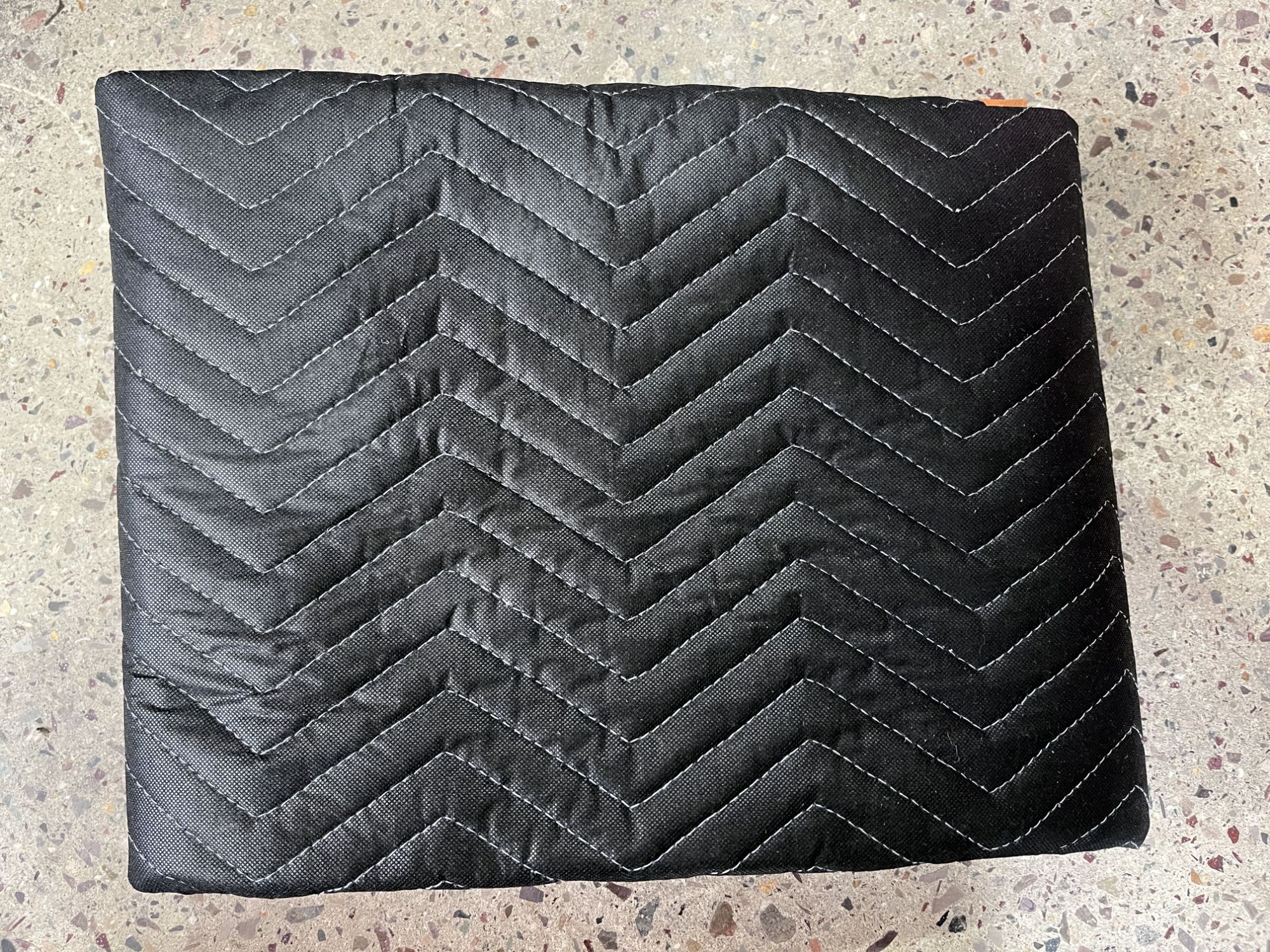
Most edge stitching looks fine on a straight run, but the real test comes when the material turns a tight corner. Cheap thread or a rushed stitch length will pucker, gap, or snap under tension, leaving a jagged line that ruins the clean geometry of a well-cut panel. This stitching is built differently. Each stitch is locked with a slight back-tension that lets the thread hug the edge without pulling the substrate out of shape, so a 90-degree bend or an acute angle comes out as crisp as the flat sections.
The secret sits in the needle path and the thread's memory. Instead of forcing a single continuous line through the turn, the machine slows and shortens the stitch just before the corner, letting the thread settle into the new direction before it's pulled tight. You won't see any skipped holes or loose loops where the angle bites hardest. The result is a line that reads as deliberate, almost drawn, across the entire perimeter.
For pieces that get handled daily, like wallet edges, seat bolsters, or bag flaps, this matters more than you'd think. Sharp corners are stress points. When the stitching holds its shape there, the whole edge gains a quiet resilience. Run a fingernail along the seam and you'll feel it: no raised bumps, no soft spots, just a continuous ridge that follows the corner like it was molded in place.
Thickness and Density Checks We Never Rush
Every batch that leaves our facility carries the weight of a simple promise: we measure twice, sometimes three times, before a single number is written down. Thickness and density aren't just specs on a sheet—they're the difference between a product that performs for years and one that fails without warning. That's why our inspection tables have no timers, only checklists. A technician will hold a caliper against the same edge until the reading stabilizes, then repeat the process on the opposite side, because uniformity matters more than speed.
Rushing a density check is how you miss a void in the core or a resin-rich pocket that looks fine on the surface. We sample from multiple points along each panel, not just the corners where flaws are rare. The densitometer gets recalibrated before every shift, and if the ambient temperature drifts more than two degrees, the whole sequence starts over. Some call it obsessive; we call it respect for the person who'll install this material in a place they can't easily inspect later.
The result of never rushing isn't just a stack of pass stamps. It's knowing that a customer won't have to call us about a delamination issue six months down the road. It's the quiet confidence that comes from pulling a random sample off the rack and getting the same thickness reading we recorded hours ago. We'd rather miss a shipment deadline by a day than ship a panel that's off by a fraction of a millimeter—because deadlines can be renegotiated, but trust cannot.
Real-Move Tests for Rips, Slips, and Abrasion
Most lab tests for fabric toughness isolate a single failure mode: a slow pull on a tensile machine, a sandpaper wheel spinning in one spot. Real-Move Tests throw that out. Instead, we strap the material to a moving knee, a twisting shoulder, a boot scraping rock. The goal is to see how rips, slips, and abrasion actually happen when a person moves—not when a machine pretends to.
For rips, we don't just measure peak force. We watch tear propagation under repeated off-axis loads. A seam might hold a straight pull but pop when a climber high-steps and the fabric rotates 40 degrees. The test rig does exactly that: grips the fabric, yanks it sideways, releases, repeats—sometimes for hundreds of cycles. Tears that start as a pinhole become the real story.
Slips and abrasion rarely show up alone. A hiker sits on rough granite, shifts weight, slides half an inch—that's abrasion and slip combined. Our test mimics that micro-movement: a loaded contact patch presses down, then drags a few millimeters, lifts, repositions. We track surface fuzz, pilling, and the point where the weave starts to shred. It's ugly, but it tells you what will fail on day four of a thru-hike.
One Standard for Every Blanket, Every Time
The idea is simple: no matter which blanket leaves the workshop, it has to meet the same uncompromising benchmark. Not the one we set last season, not “good enough for the price,” but the one that has guided every stitch from the start.
That means inspecting the weave for loose threads before it ever touches a sewing machine. Feeling the binding between fingers to catch any rough edge. Folding and refolding to make sure the drape falls exactly the same as the sample we approved months ago. If a single blanket falls short, it doesn’t go into a box; it goes back.
This isn’t about occasional quality checks. It’s about making the standard so routine that the exceptional becomes ordinary. Every blanket, every time, same answer: yes, this one meets it.
Safety Cues Built Into the Blanket’s Design
Stitched along one edge, a row of raised dots tells your fingers which end is up without needing to look.
The binding uses a subtle color shift on the underside, so you can spot at a glance whether the blanket is facing the right way before tucking it around someone.
Corner loops are reinforced with contrasting thread, giving a quick visual and tactile check that the blanket is securely fastened to a chair or bed frame.
FAQ
We pull random samples every 200 units and measure weight, thickness, and stitching tension. If any sample falls outside the set range, the entire batch gets re-inspected before packing.
The edges are double-folded and finished with a dense overlock stitch using high-tenacity polyester thread. That stops unraveling even when the blanket scrapes against door frames or concrete.
The polypropylene fibers are hypoallergenic and don't shed the way woven cotton does. We also avoid latex and use water-based binders, so there's no chemical smell that lingers.
We run a grab test on fabric swatches from each roll. The material must hold at least 50 pounds of force before a tear starts, otherwise the roll is rejected.
Yes, the fabric is treated with a non-toxic fire retardant that passes standard safety tests. It won't leave residue on furniture or cause skin irritation with normal handling.
We quilt the blankets in a diamond pattern and use a locking stitch at every intersection. That keeps the inner padding from shifting or bunching up, even after being folded and stored many times.
We make a standard 80-gram blanket for small local moves and a heavy-duty 120-gram version for long hauls or commercial jobs. Both meet the same tear and fire safety requirements.
If a blanket arrives with a skipped stitch, tear, or uneven padding, we replace it at no cost. We don't sell factory seconds, so defective items are pulled and recycled before they reach the warehouse.
Conclusion
At Non-Woven Moving Blanket Company, safe moving starts with fabric that refuses to let go. Our non-woven material is engineered with a textured grip surface, so even heavy furniture stays put on the truck bed without sliding or shifting mid-transit. That grip works hand-in-hand with edge stitching designed to survive sharp metal corners, box staples, and rough brick walls—no frayed seams or burst threads after repeated drags. Beneath the surface, every batch undergoes thickness and density checks we never rush, measuring fiber weight and loft to ensure each blanket delivers consistent cushioning against impact. A thin spot isn't just a flaw; it's a risk we refuse to ship.
Before any blanket earns our label, it must pass a gauntlet of real-move tests: simulated lift-and-drag cycles across concrete, abrupt pulls, and abrasion trials that mimic the scrape of a china cabinet against a stairwell. We look for rips, slips, and wear patterns, rejecting anything that doesn't hold up. That same standard applies to every blanket we produce—no factory seconds, no quiet downgrades. Safety cues are built into the design itself, from high-visibility binding edges that warn when a corner is about to catch, to reinforced corner seams that telegraph strength at a glance. For us, quality isn't a batch-to-batch hope; it's a fused feature of every blanket, every time, so you can focus on the heavy lifting while we handle the protection.
Contact Us
Contact Person: Shelly
Email: [email protected]
Tel/WhatsApp: 86-577-64286522
Website: https://www.topmovingpad.com/