

OEM Stainless Steel Carriage Bolt Essentials: What Buyers Need to Know
2026-10-14
Ask any engineer who's had to replace rusted carriage bolts on a marine dock, and they'll tell you: stainless steel isn't a guarantee—it's a specification. The real question is which specification your supplier actually follows. This primer covers the essentials OEM buyers often overlook, from raw material traceability to final inspection, with a closer look at how Wanluo approaches each step.
Don't Let '18-8' Fool You: Stainless Steel Grade Choices
The familiar '18-8' label on your stainless steel water bottle or kitchen sink refers to a general family of austenitic stainless steels containing roughly 18% chromium and 8% nickel. It is often used as shorthand for Type 304, the most common stainless grade. But '18-8' is not a formal specification, and it can quietly hide meaningful variations in performance. Depending on the exact chemical composition, two pieces of metal both called '18-8' may behave quite differently when exposed to salt, acids, or extreme temperatures.
For example, Type 304 and Type 316 are both '18-8' in the broad sense, yet 316 adds molybdenum to resist chloride pitting far better than 304. That makes 316 the preferred choice near coastal areas or in food processing with salty brines. On the other hand, lower-nickel grades like 201 or 202 can sometimes be marketed as '18-8 type' but offer weaker corrosion resistance and are more prone to rust in demanding environments.
The real takeaway is to look beyond the nickname. If your application involves heat, welding, strong acids, or constant moisture, check the actual grade number and its ASTM or EN designation. A few minutes spent confirming whether you need 304, 316, or something else can prevent premature rust, pitting, or structural failure down the line.
Tight Tolerances: Where Fit Problems Begin and End
Every machinist knows the sinking feeling of a part that slides together perfectly on paper but jams, rattles, or refuses to seat on the shop floor. That gap between design intent and physical reality often traces back to one thing: tolerances that are tight in all the wrong places. When a bore and shaft are each held to a few microns, the assumption is a precision fit—but stack those tolerances across a housing, a bearing set, and thermal expansion, and the "perfect" clearance disappears. The result is interference you can't see until it's too expensive to fix.
The fix isn't to loosen everything—it's to get intentional about which features actually need extreme accuracy and which can breathe. Functional tolerancing, where you analyze the tolerance stack for the entire assembly rather than each part in isolation, turns potential disasters into predictable fits. For instance, specifying a maximum material condition on a locating pin and a minimum material condition on its mating hole lets the inspector verify clearance without holding both parts to the same punishing band. This approach doesn't just save money on scrapped parts; it makes the assembly robust to the normal variation that every process produces.
Perhaps the hardest lesson is that tight tolerances are a design choice, not a quality goal. When you tighten a dimension without understanding how the mating part will respond under load, temperature, or even gravity, you're not improving the product—you're betting against reality. Successful engineers treat tolerances as a conversation between parts. They map the functional requirements, account for real-world drift, and then give each feature the loosest tolerance that still guarantees performance. That is where fit problems end: not on the inspection report, but at the moment the design stops fighting the manufacturing process.
Surface Finish: More Than a Shiny Head
Surface finish frequently gets reduced to a simple question of gloss or reflectivity, but that misses the point entirely. The microscopic peaks and valleys left by machining, grinding, or polishing control how a part seals against fluids, resists corrosion, sheds debris, and even how much friction it generates during start-up. A mirror-bright face on a cylinder head might look impressive, yet if the lay of the surface runs the wrong way, oil can weep past a gasket or exhaust gases can find a path to the cooling jacket.
The real challenge is specifying and verifying the right texture, not the shiniest one. Parameters like Ra, Rz, and waviness tell different stories depending on whether you care about bearing load distribution, paint adhesion, or break-in behavior. Over-polishing can be just as harmful as leaving deep tool marks; a too-smooth bore may not retain oil well, and a lapped sealing face can fail if it lacks enough micro-channels to accommodate thermal movement. That’s why experienced engineers treat surface finish as a design variable with tolerances, not a cosmetic afterthought.
Custom Markings and Packaging Without Extra Hassle
Getting your logo, part numbers, or handling notes onto products usually means juggling outside vendors, setup charges, and minimum order quantities that never line up. We keep marking and packaging inside the same production flow, so what you specify is exactly what arrives—no chasing proofs or re-approving artwork after the fact.
Laser etching, inkjet coding, label placement, custom bagging, barcoding, and odd-size cartons are all handled under one roof. Send a drawing, a label file, or a rough sketch, and it becomes a repeatable spec. Short runs aren’t penalized, and changes can be made between batches without starting the order over.
Because marking and packing are tied to the same quality checks as the product itself, you don’t end up with good parts in mislabeled boxes or labels that wear off in transit. One purchase order covers the whole job, and the packing slip matches the carton contents every time.
Batch Consistency: The Make-or-Break Factor in Bulk Orders
When a buyer places a bulk order, the expectation isn't just that the first few units look right. It's that unit 500 matches unit 5, and that unit 10,000 still falls within the same tolerances. Batch consistency is where many suppliers quietly fail. A pilot run can be flawless, but tooling wear, raw material lots shifting from one delivery to the next, and operator drift across shifts all chip away at uniformity. If no one is tracking those variables batch to batch, the customer ends up with a shipment that has to be sorted, reworked, or rejected outright.
The real test is whether your process controls are documented and tied to actual measurements, not just a final visual check. Things like recording oven temperature curves, injection pressure, or humidity levels at regular intervals might seem tedious, but that data is what lets you catch a drift before it becomes a defect. A supplier who can show trend charts from the last three production runs—and explain what changed when a parameter moved—is one who understands that consistency is managed, not assumed.
Ultimately, batch consistency affects more than the product itself. It determines whether the buyer has to hold extra safety stock, deal with unpredictable assembly line stoppages, or field complaints from their own customers. A vendor who delivers the same outcome every time, even when the order size doubles or the season changes, removes a whole layer of risk from the buyer's operation. That reliability is often worth more than a slightly lower unit price.
Vetting Suppliers: Questions That Reveal the Truth
Ask for a specific failure story, not a success story. “Tell me about the last time a shipment arrived late or a batch failed inspection. What did you do after you found out?” A supplier who immediately blames the shipping line, the raw material vendor, or your own spec sheet is showing you how they’ll treat you when something goes wrong. A supplier who walks you through their mistake, the call they made to the client, and the corrective action they took is rare—and worth keeping.
Then push on capacity and focus. “Which of your current clients make a product similar to mine? What percentage of your output is in this category?” If they name brands or factories you recognize, that’s useful. If they say “we can produce anything” or “we have no competitors in this area,” that’s a signal to dig deeper. A good supplier knows exactly which SKUs they’re strong at and will tell you what they don’t do well.
Finally, test their process with questions about follow-up. “Can you share the last three internal QC reports from a live order? What happens if I find a defect after shipping—who pays for the replacement?” The answers should be immediate and boring. Long pauses, vague promises, or “don’t worry, we have never had a quality issue” are more telling than any factory audit.
FAQ
For coastal or marine exposure, 316 stainless is the safer choice because of its molybdenum content. Ask for test reports showing actual alloy composition rather than just a stainless label, and confirm the bolts can handle the expected chloride levels without pitting.
Custom head markings, non-standard lengths, or special thread pitches usually push lead times to 30–45 days and often require 10,000 to 50,000 pieces per size. If you can work with standard dimensions and add branding later, you'll typically get faster turnaround and lower minimums.
A passivated finish is the baseline for corrosion resistance, but if you need lower reflectivity or better paint adhesion, a matte or electro-polished finish may be worth it. Avoid coatings that hide surface defects; a clean, uniform finish tells you more about the raw material quality.
The most common causes are using 304 in chloride-heavy environments, skipping proper passivation after machining, or sourcing from mills with inconsistent nickel content. Ask for batch-level material certificates and inspect a random sample for signs of surface contamination or rough threads.
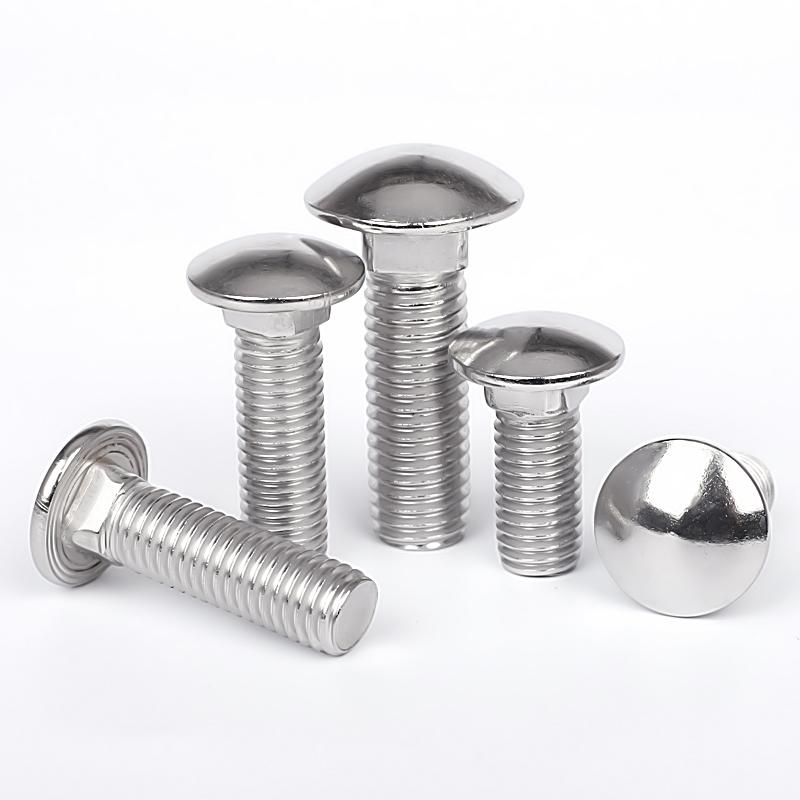
Carriage bolts typically follow DIN 603 or ASME B18.5, but the thread pitch and head dimensions can vary by region. Confirm whether you need full threads or a specific grip length, and request a dimensional drawing before production so the square neck seats correctly in pre-punched holes.
Request pre-production samples from the same tooling and raw material batch. Check for consistent dome height, square neck alignment, and smooth thread formation. Then have a third-party lab test a few pieces for chemical composition and salt spray resistance if the application is critical.
Prices can vary widely based on diameter, length, alloy grade, and order volume, but 304 bolts typically cost 20-40% less than 316. The biggest cost drivers are raw material price fluctuations, custom head marks, and any secondary operations like drilling or patching.
Cold heading is more economical for high volumes and produces stronger threads through work hardening, but it may not suit very complex or low-volume custom shapes. Machining makes sense for short runs or unusual dimensions, though it costs more and removes material rather than flowing it into shape.
Conclusion
Buyers often assume "18-8" stainless tells the whole story, but grade selection is more nuanced. A2 and A4 grades behave differently in chloride or acidic environments, so matching the bolt material to the actual exposure matters more than a generic label. Tolerance control is where many OEM projects stall: a shank that is a few thousandths off can compromise pre-drilled holes, slow assembly, or create stress points. Insist on documented dimensional checks rather than accepting "close enough." Surface finish deserves equal attention. Passivation quality, burr removal, and thread condition affect corrosion resistance and torque consistency far more than a polished dome. A dull but properly passivated fastener often outperforms a shiny one with residual iron contamination.
Custom markings and packaging should not become a logistical headache. Clear part numbers, lot codes, and even color-coded labels can be handled at the factory if specified early, but vague requests lead to mix-ups. Batch consistency is the real make-or-break issue in bulk orders. A single lot with variable hardness, thread form, or dimensional drift will cause more downtime than a slightly higher unit price ever would, so request batch samples and test reports before committing. Finally, vetting suppliers requires asking pointed questions: How do they segregate heats? What inspection tools do they use on the line? Can they provide traceability from raw coil to finished carton? Direct answers to these questions reveal whether a supplier controls the process or just buys and resells. The best OEM partners treat carriage bolts as engineered components, not commodities.
Contact Us
Contact Person: Shane
Email: [email protected]
Tel/WhatsApp: 8613357785029
Website: https://www.wanluohardware.com